

Before the number, the rules
Most Melbourne homeowners start a kitchen renovation by asking what it’ll cost. That’s the wrong first question. Victorian law sets three thresholds that reshape what any quote can legally include, and those thresholds moved in July 2026. Get them right first, then talk price.
The short answer: three thresholds that matter
These are separate rules at separate dollar amounts. Treat them individually.
- Over $10,000 of domestic building work: a Building and Plumbing Commission (BPC) registered builder is required.
- Over $20,000 of domestic building work: a Major Domestic Building Contract is required. This threshold rose from $10,000 to $20,000 on 1 July 2026 as part of the BPC reforms.
- Over $20,000 of eligible domestic building work: Home Warranty insurance is required, replacing Domestic Building Insurance from 1 July 2026 for projects up to three storeys.
A $12,000 cosmetic refresh and a $45,000 full renovation aren’t the same job in the eyes of the regulator. The registered-builder rule applies to both. The contract and insurance rules only kick in above $20,000.
What every quote should account for
Three regulated inputs sit in every legitimate Melbourne kitchen quote.
A BPC-registered builder for the building work, once you’re over $10,000. Check the register before signing anything.
A registered electrical contractor for every electrical task: new circuits, moved GPOs, hardwired appliances, rangehood wiring. Electrical work must be done by a registered electrical contractor in Victoria. No handyman carve-outs.
A BPC-licensed plumber for any plumbing. Sink relocation, dishwasher plumbing, gas disconnection. Plumbing work valued at $750 or more also requires a compliance certificate, and only a licensed plumber can issue one. If the quote hides plumbing under “general trades”, that’s a problem.
Deposits are also capped. For a domestic building contract under $20,000 the maximum deposit is 10%. For contracts of $20,000 or more it drops to 5%. If a builder asks for 20% upfront, they’re outside the law.
What actually changes the number
Scope drives price. These are the levers, in rough order of impact.
Size and layout. A like-for-like swap in the existing footprint is one job. Moving the sink, cooktop or fridge to a new wall is another. New plumbing runs, new electrical circuits, often patching to floor and ceiling.
Cabinetry tier. Flat-pack, local custom and imported European are three different price brackets. The carcass is often similar; doors, hinges and drawer runners are where the money sits.
Benchtop material. Engineered stone has been banned nationally in Australia since 1 July 2024. The ban covers reconstituted stone too — it’s engineered stone under another name. The realistic choices now are natural stone, porcelain or sintered stone, laminate, and solid timber. Each sits at a different price point and has different lead times.
Appliances. Induction cooktops, integrated dishwashers and pyrolytic ovens push the appliance line hard. Spec these early. They drive cabinetry dimensions.
Structural and services work. Removing a wall, upgrading the switchboard, adding a dedicated oven circuit, moving a gas point. Any of these can add thousands.
Access. Second-storey walk-ups, narrow laneways and strata loading dock bookings all add time, and time is labour.
If you want a working figure before you call a builder, plug your kitchen size and finish into the calculator and use the output as a sanity check against quotes.
How to reduce it without cutting quality
Keep the layout where you can. Plumbing and electrical moves are expensive and invisible once the splashback is up.
Mix cabinetry tiers. Custom where it’s seen, flat-pack in the pantry.
Order appliances early. Backorders on ovens and integrated dishwashers push out the whole program, and delays cost more than the appliance.
Get three quotes on identical scope. Not three quotes on three different interpretations of the same brief. Write the scope down and hand the same document to each builder.
Lock scope before signing. Variations mid-build are where budgets break.
The line most homeowners forget: the cost of being without a kitchen for the duration. Six weeks of takeaway for a family of four isn’t a rounding error. Factor it in before you sign, not after. For what actually drives the length of the build, see what drives a Melbourne kitchen renovation timeline. For the four realistic options Melbourne households use while the kitchen is out, see temporary kitchen options compared.
When a temporary kitchen pod makes sense
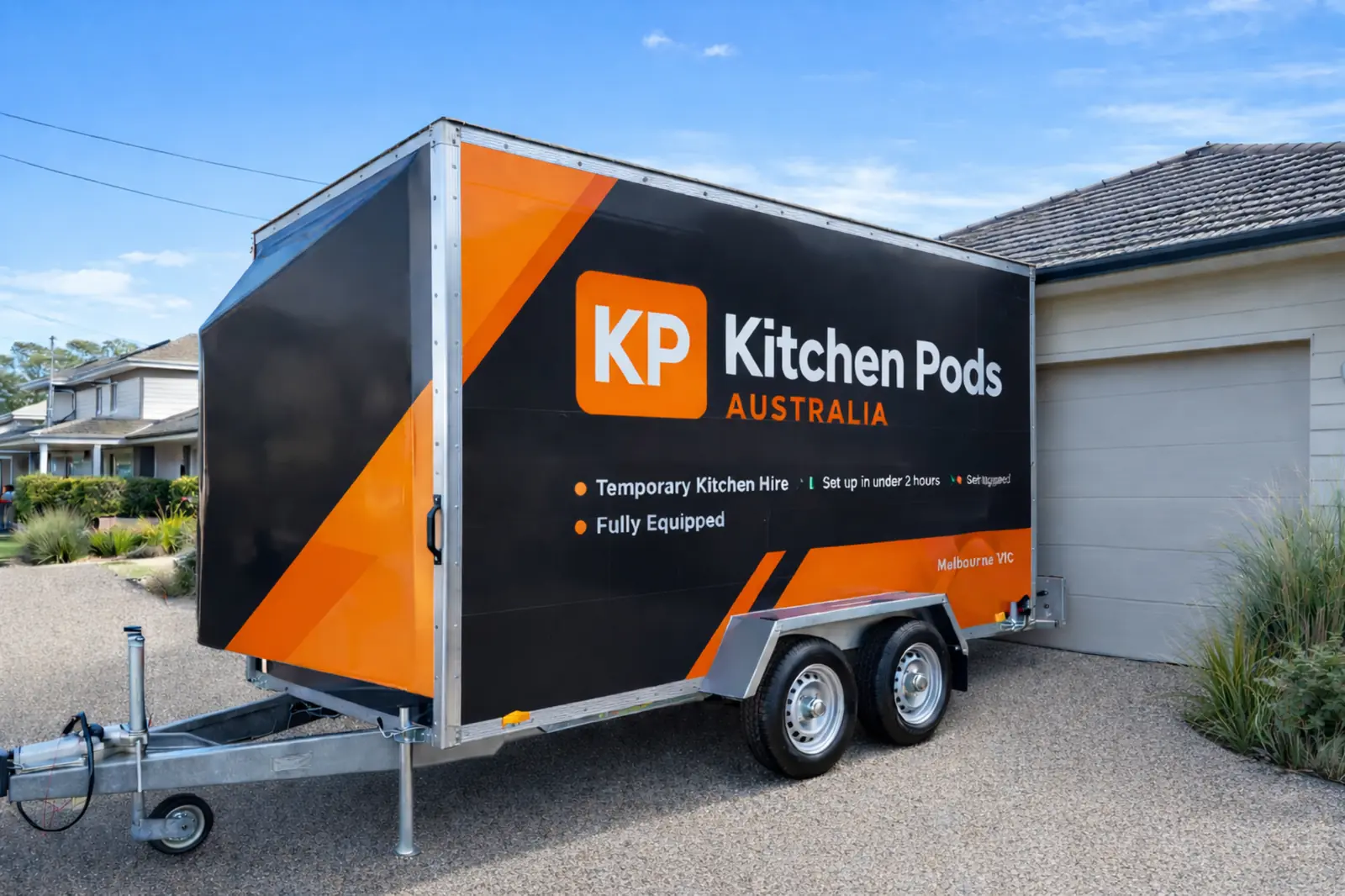
Our hire starts at three weeks. Past that, a self-contained kitchen on the driveway starts to pencil out against takeaway, cafe breakfasts and the slow erosion of patience. We deliver a pod to Greater Melbourne that gives you a working kitchen for the duration of the build.
Two variants. The Battery Pod runs from an ordinary 10A power point. The 15-Amp Pod runs from a dedicated 15A circuit installed by the builder’s electrician. Appliances are the same across both:
- Two-burner induction hob (mats provided)
- 27L fan-forced oven
- 175L fridge freezer
- Sink with hot (not boiling) water tap
- Built-in Omega 45cm dishwasher
- Camec Compact 4kg washing machine
- Dinette seating for four
No prep bench.
Water is self-contained. A 90-litre fresh tank is filled by drinking-water-safe hose from an outdoor mains tap. A 110-litre grey tank is pumped out or discharged direct to an overflow relief gully where the property has one. No plumbing connection is made to the household’s water system.
Site requirement: a level, firm area of at least 7 metres by 3.5 metres, on the driveway or a hardstand area. Sloping ground, soft ground and non-firm surfaces are the usual disqualifiers. Tight bends or limited reverse-in access aren’t automatic knock-outs — we scope those site by site before quoting.
For the full spec sheet and what the driver needs on delivery day, see temporary kitchen inclusions and site requirements.
Kitchen out for a reno? Request a quote at hello@temporarykitchenco.com.au. Greater Melbourne.
Bottom line
Three thresholds, one line each.
- Over $10,000: BPC-registered builder.
- Over $20,000: Major Domestic Building Contract.
- Over $20,000: Home Warranty insurance.
Add a registered electrical contractor and a BPC-licensed plumber for any plumbing work, respect the deposit caps, and know that engineered stone — including reconstituted stone — is off the benchtop menu. The specific number for your kitchen comes out of the calculator, not this guide. Use the calculator for the dollars. Use this piece for the decisions around them.