

The number on the renovation schedule says six weeks. Reality is usually longer and harder than the number suggests. This piece isn’t about cost or timeline — the companion guides cover those. It’s about what the weeks actually feel like inside a Melbourne household when the kitchen is gone.
The short answer
A typical Melbourne kitchen reno runs weeks on site, plus the lead-time weeks before anyone picks up a hammer. The wider context: Master Builders Australia reports whole-of-build durations averaging 11.5 months for houses and 14.8 months for townhouses nationally, which tells you how stretched trades are even if it doesn’t speak to kitchens specifically. For the kitchen-specific drivers, see what drives a Melbourne kitchen renovation timeline.
The felt experience runs longer than the figure suggests. Week one feels novel. By week three the routines are strained. By week six the household is tired. By week ten, if things slip, people get short with each other over small things.
What it actually takes out of a household
The dollar cost is one thing. The cost guide handles that — see what drives Melbourne kitchen renovation costs. The costs that don’t show up on an invoice are harder to plan for.
Mental load. Someone has to plan every meal, every day: where breakfast is coming from, what’s in the bar fridge, whether there’s milk. That decision load lands on one person in most households, and it compounds over weeks.
Routine disruption. School lunches become a logistics problem. Breakfast schedules collide because the kettle, the toaster and the one working powerpoint are all in the same spot. The question of who cooks what, which was settled, is suddenly open again.
The social hub, gone. The kitchen’s where people hang around the island, where dinner happens together, where the day gets debriefed. Replace it with a camp setup on a trestle table and the household stops gathering. People eat on their laps in separate rooms. Six weeks of that changes the feel of the house.
Overflow into other rooms. The camp-cooking setup lands wherever power and water meet, which often means the laundry gets displaced into bedrooms. If someone works from home and the camp kitchen ends up in the home office, the home office becomes a kitchen. Meetings happen with a microwave beeping in the background.
What changes the number
Two households can face identical renovation timelines and have completely different experiences. The variables that matter:
- Household size. A single adult eating out most nights barely notices. A family of four with a dog notices by day three.
- Cooking habits. If you cook from scratch daily, losing the kitchen is a daily problem. If your baseline is takeaway twice a week and microwave meals, the gap’s smaller.
- Work-from-home density. Both adults working from home means lunch is a problem five days a week, not two. It also means the house gets no break from the renovation noise.
- School-age kids. Lunchbox pressure doesn’t pause. Neither does the after-school snack window.
- Dietary needs. Fridge-dependent medications, allergen cross-contamination risks, and specific dietary requirements don’t fit a bar fridge and a sandwich press.
- Pets. Feeding stations, water bowls, and the specific corner the cat eats in all need somewhere to go.
The ABS tracks household spending on hotels, cafes and restaurants monthly, which gives a national baseline for what eating out costs the average household. For your specific numbers, plug your household numbers into the eating-out calculator.
How to reduce it
Four realistic strategies. Each suits a different kind of household.
- Eat out and order in. Suits small households, high-income earners without kids, and short renovation windows. Gets expensive and tiring fast with a family.
- Set up a camp kitchen. Suits households with space to lose for weeks and the patience to live with it. Fine for three or four weeks. Grim at eight.
- Move out. Suits households without pets, with flexible work, and with somewhere to go. Rarely cheap once you factor in short-stay rates across a Melbourne winter.
- Hire a self-contained kitchen pod. Suits households that want to stay in the house, have the driveway space, and are out of the kitchen for longer than a few weeks.
For the full side-by-side with the four realistic options compared side by side, the comparison guide covers mechanics, trade-offs, and when each one breaks down.
When a pod makes sense
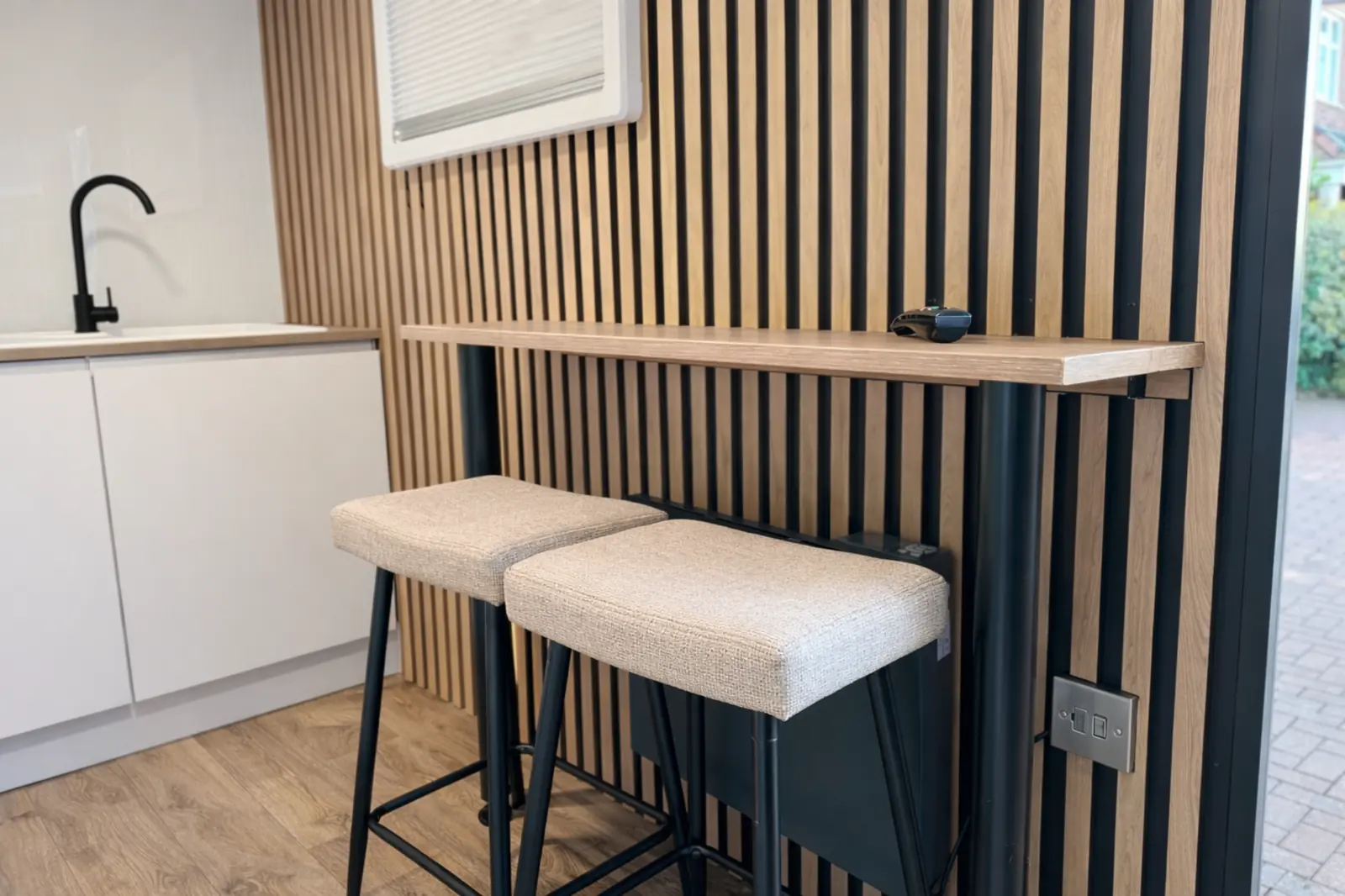
A kitchen pod is a self-contained unit delivered to the driveway or a hardstand area. It comes with its own power connection, onboard fresh and grey water tanks, two-burner induction cooktop, 27-litre oven, 175-litre fridge-freezer, built-in dishwasher, washing machine, and dinette seating for four. Two variants: a Battery Pod that runs from an ordinary 10A power point, and a 15-Amp Pod that runs from a dedicated 15A circuit installed by the builder’s electrician.
Site needs: a level, firm pad of at least 7 metres by 3.5 metres. The pod itself is 4m × 2.25m excluding the drawbar; the rest is clearance for the drawbar and access room. Minimum hire is three weeks.
Three questions make the fit obvious:
- Are you out of the kitchen for longer than three weeks?
- Do you want to stay in the house through the renovation?
- Do you have driveway or hardstand space that meets the pad requirement?
Three yeses and it’s worth a quote. For what’s included and site requirements for a temporary kitchen, the hire page lays out the spec and the site checks in full.
Bottom line
Household factors beat cost maths. The “cheapest” way through a kitchen renovation depends entirely on who’s in the house, what they eat, where they work, and whether there are kids or pets in the mix. A spreadsheet comparing weekly rates misses most of what makes six weeks without a kitchen hard.
Start with an honest look at your household. Then pick the strategy that fits the way you actually live, not the one that looks tidiest on paper.
Kitchen out for a reno? Request a quote at hello@temporarykitchenco.com.au. Greater Melbourne.